Wednesday, March 2, 2011

March 2011 Fossil of the Month

Fossil Plants


Paleobotany, from the Greek words “paleon”, meaning old and "botany", meaning the study of plants), is the branch of paleontology or paleobiology dealing with the recovery and identification of plant remains from geological contexts.

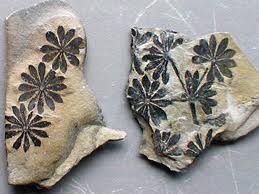
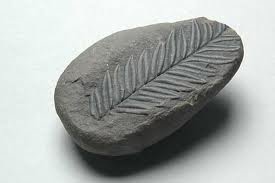
A plant fossil is any preserved part of a plant that has long since died. Such fossils may be prehistoric impressions that are many millions of years old, or bits of charcoal that are only a few hundred years old. Prehistoric plants are various groups of plants that lived before recorded history (before about 3500 BC). Plant fossils can be preserved in a variety of ways, each of which can give different types of information about the original parent plant.

1. Adpressions (compressions-impressions). These are the most commonly found type of plant fossil. They provide good morphological detail, especially of dorsiventral (flattened) plant parts such as leaves. If the cuticle is preserved, they can also yield fine anatomical detail of the epidermis. Little other detail of cellular anatomy is normally preserved.

2. Petrifactions (anatomically preserved fossils). These provide fine detail of the cell anatomy of the plant tissue. Morphological detail can also be determined by serial sectioning, but this is both time consuming and difficult.

3. Molds and casts. These only tend to preserve the more robust plant parts such as seeds or woody stems. They can provide information about the three-dimensional form of the plant, and in the case of casts of tree stumps can provide evidence of the density of the original vegetation. However, they rarely preserve any fine morphological detail or cell anatomy. Subsets of such fossils are pith casts, where the center of a stem is either hollow or has delicate pith. After death, sediment enters and forms a cast of the central cavity of the stem.

4. Authigenic mineralization. These can provide very fine, three-dimensional morphological detail, and have proved especially important in the study of reproductive structures that can be severely distorted in adpressions. However, as they are formed in mineral nodules, such fossils can rarely be of large size.

5. Fusains. Fire normally destroys plant tissue but sometimes charcoalified remains can preserve fine morphological detail that is lost in other modes of preservation; some of the best evidence of early flowers has been preserved in fusains. Fusains fossils are delicate and often small, but because of their buoyancy can often drift for long distances and can thus provide evidence of vegetation away from areas of sedimentation.


Wednesday, February 2, 2011

February 2011 Fossil of the Month

Fossil Sea Shells


Imagine that you are hiking in
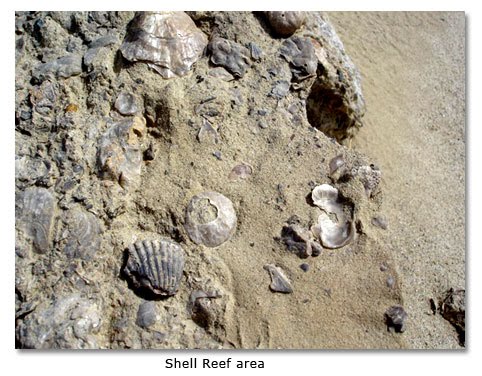
California’s blazing desert, 100 miles from the Pacific coastline. Imagine the huge mountains and the winding canyons that would surround you. Cacti dot the sandy landscape. What is the last thing you would expect to find? Seashells! Yet find them you will: in dried out washes, on an ancient shell reef, in canyon walls. Located 20 to 25 miles west of today’s El Centro, California, the basin offers a vast shell bed of 6-million-year-old oyster fossils. Erosion has left the dry wash streambeds littered with the shells. Strata in the streambed walls clearly show where oysters once covered the basin floor. California’s Shell Reef, located in the middle of an active off-road vehicle area in Anza Borrego State Park, is another treasure trove of fossils. Although a small fence protects the reef, you can still enter the area and examine the fossilized oyster shells. Shell Reef formed about four million years ago. We could also search America’s Great Plains, more than 1000 miles east of the California Desert. Any chance we might find seashells there, in the middle of the continent? You bet. The shells provide evidence of an ancient sea – the Western Interior Seaway – that existed in what is now America’s Heartland. Over time, the Western Interior Seaway receded, leaving the floor exposed. Vast rock and sediment layers remain along with fossils from creatures that once lived in the sea. The Pierre Shale is a formation deposited by the Western Interior Seaway. Exposures occur in Canada and in many U.S. states, including South Dakota, Colorado, Nebraska, Minnesota, New Mexico and Wyoming. The shale contains many species of fossilized shells, including ammonites, which we will be covering in depth as they are scheduled to be a future fossil of the month.

Wednesday, January 5, 2011

January 2011 Fossil of the Month

Fossil Teeth

Shark------------------ Megalodon----------

Alligator----------- Orca Killer Whale

The most commonly found fossil teeth are shark teeth although mammoth, mastodon, horse, bison, primate, and the teeth of skates, rays, whales and dolphins are also highly sought after. In general, the larger the tooth the more valuable although value is also based on whether the fossil teeth are rare. For example, mastodon teeth are smaller than mammoth teeth but are more valuable due to the rarity of the mastodon teeth. Fossil teeth found take many different forms. Many animals, including mammoths, sharks and reptiles go through quite a few sets of teeth during their lifetime, making it easier to find them.

Mammoth teeth are often found after being tossed around by the ocean for many years, so their appearance may be rounded. Mammoth teeth from the Pleistocene can be found in the North Sea, Alaska and Russia among other places.

Mastodon teeth are most commonly found from the Shovel-Tusker Mastodon, since the teeth from the American Mastodon are much harder to find. Both the Shovel-Tusker Mastodon and the American Mastodon are a part of an extinct group of proboscidians with cusped molar teeth.

The teeth of a shark are the only part of its body that is easy to fossilize because they are made up of bone while the rest of the shark is made up of cartilage. Small shark teeth are extremely common on some East Coast beaches but larger fossilized shark teeth are harder to find. The Megalodon shark was over 40 feet long and is now extinct. Fossil teeth from this shark are extremely valuable and are about 3 times as big as the teeth from a great white shark. Alligator teeth are commonly found in Florida. These fossil teeth are very important to the study of terrestrial vertebrates in North America. Many species of fossil whale teeth can be found in both North & South Carolina as well as several other locations around the world.

Mosasaur----------Mammoth-------Shark


Wednesday, October 6, 2010

October 2010 MIneral of the Month

Brazilian Agate


Brazilian agate is a variety of chalcedony and comprised of cryptocrystalline quartz. It has a hardness of 6.5 to 7.5 on the Mohs scale. It occurs in bands of varying color and transparency. The Brazilian varieties are characterized by peculiarities in the shape and color of the bands, which can be seen in sections when cut at right angles to the layers. The banding in Brazilian agates forms as silica from ground water is slowly deposited into cavities and veins in the older rock. Agate is found throughout the world as nodules in volcanic or other eruptive rock and also in hollow geode form. Brazil is a major producer of agates. Agates are identical in chemical structure to jasper, flint, chert, petrified wood, and tiger's-eye, and are often found in association with opal. The colorful, banded rocks are used as a semiprecious gemstone. Brazilian agates can be artificially stained to produce a combination of colors more vivid than those found in the natural state. The agates from Brazil are mostly mined from decomposed volcanic ash and basalt from the late Permian age (248-275 million years ago) In Rio Grande do Sul the "agate mines" are normally just plowed fields in which loose agates are found and collected. Brazilian agates are very colorful stones with some of the most beautiful inclusion and structures imaginable. Agate is very hard and takes an excellent polish. Sadly, most of the market for Brazilian agates is for the dyed versions of these stones. When you see a pink,
teal, purple or green agate it is dyed and not natural.

Support the Rock Chippers and attend their show this Month!


Please support the Rock Chippers and attend their show.


!! FREE ADMISSION!! !! FREE ADMISSION!! !! FREE ADMISSION!!

An educational non-profit community organization

WOODLAND HILLS ROCK CHIPPERS, INC.

TWELFTH ANNUAL

GEM SHOW

Saturday, 10:00 am – 5:00 pm FIRST UNITED METHODIST CHURCH

OCTOBER 16, 2010 22700 Sherman Way, West Hills, CA 91303

CRAFTS - FOOD - JEWELRY – DEALERS

GEMS Ù  MINERALS - ROCKS Ù  FOSSILS

DISPLAYS Ù  DEMOS - SILENT AUCTIONS

HANDS-ON ACTIVITIES THROUGHOUT THE DAY

FOR INFORMATION E-MAIL

info@rockchippers.org

!! FREE ADMISSION!!