Petrified Wood


The Del-Air Rockhounds Club Corporation Los Angeles - San Fernando Valley, California, United States - We are a non-profit organization dedicated to sharing knowledge of the lapidary arts and techniques, geology, mineralogy and related fields.


When trilobites first appeared in the fossil record they were already highly diverse and geographically dispersed. Because trilobites had wide diversity and an easily fossilized exoskeleton an extensive fossil record was left, with some 17,000 known species spanning the Paleozoic era. The study of these fossils has facilitated important contributions to biostratigraphy, paleontology, evolutionary biology and plate tectonics.
Trilobites had many life styles; some moved over the sea-bed as predators, scavengers or filter feeders and some swam, feeding on plankton. Most life styles expected of modern marine arthropods are seen in trilobites, with the possible exception of parasitism where there is still some scientific debate. Some trilobites are even thought to have evolved a symbiotic relationship with sulfur-eating bacteria from which they derived food. Trilobites range in length from .04 inch to 28 inches, with a typical size range of 1-4 inches. The world's largest trilobite, Isotelus rex, was found in 1998 by Canadian scientists in Ordovician rocks on the shores of Hudson Bay. It measured 28 inches long by 16 inches wide by 3 inches high.Paleobotany, from the Greek words “paleon”, meaning old and "botany", meaning the study of plants), is the branch of paleontology or paleobiology dealing with the recovery and identification of plant remains from geological contexts.
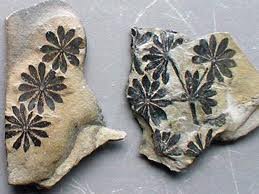
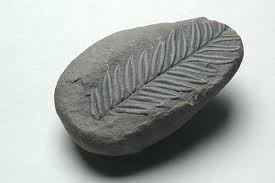
A plant fossil is any preserved part of a plant that has long since died. Such fossils may be prehistoric impressions that are many millions of years old, or bits of charcoal that are only a few hundred years old. Prehistoric plants are various groups of plants that lived before recorded history (before about 3500 BC). Plant fossils can be preserved in a variety of ways, each of which can give different types of information about the original parent plant.
1. Adpressions (compressions-impressions). These are the most commonly found type of plant fossil. They provide good morphological detail, especially of dorsiventral (flattened) plant parts such as leaves. If the cuticle is preserved, they can also yield fine anatomical detail of the epidermis. Little other detail of cellular anatomy is normally preserved.
2. Petrifactions (anatomically preserved fossils). These provide fine detail of the cell anatomy of the plant tissue. Morphological detail can also be determined by serial sectioning, but this is both time consuming and difficult.
3. Molds and casts. These only tend to preserve the more robust plant parts such as seeds or woody stems. They can provide information about the three-dimensional form of the plant, and in the case of casts of tree stumps can provide evidence of the density of the original vegetation. However, they rarely preserve any fine morphological detail or cell anatomy. Subsets of such fossils are pith casts, where the center of a stem is either hollow or has delicate pith. After death, sediment enters and forms a cast of the central cavity of the stem.
4. Authigenic mineralization. These can provide very fine, three-dimensional morphological detail, and have proved especially important in the study of reproductive structures that can be severely distorted in adpressions. However, as they are formed in mineral nodules, such fossils can rarely be of large size.
5. Fusains. Fire normally destroys plant tissue but sometimes charcoalified remains can preserve fine morphological detail that is lost in other modes of preservation; some of the best evidence of early flowers has been preserved in fusains. Fusains fossils are delicate and often small, but because of their buoyancy can often drift for long distances and can thus provide evidence of vegetation away from areas of sedimentation.